
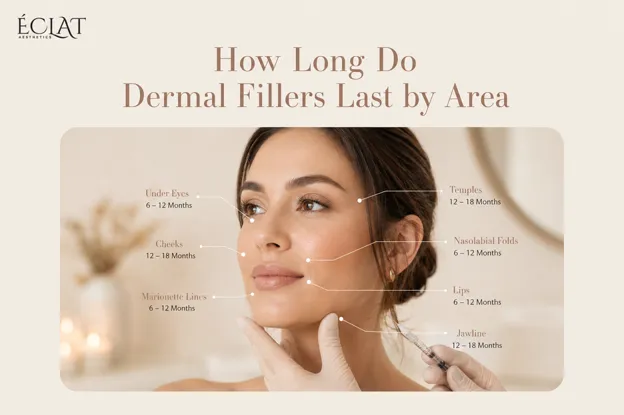
Dermal fillers can restore lost facial volume, enhance natural contours, soften lines, and create subtle changes without surgery. They are commonly used to enhance the lips, restore cheek volume, define the jawline, and improve overall facial balance.
One of the first questions patients ask before treatment is, how long do fillers last? The answer depends on much more than the brand of filler being used. The treatment area, type of filler, amount injected, facial movement, metabolism, and individual anatomy can all influence how long the visible result remains.
At Eclat Medical Aesthetics in Alpharetta, dermal filler treatments are personalized according to each patient's facial structure and aesthetic goals. Eclat's approach focuses on enhancing natural features rather than dramatically changing the face, with treatment plans designed around facial balance and individual anatomy.
Although fillers are temporary, they do not necessarily disappear according to one exact timeline. Lip filler may fade differently from cheek filler, and a structural filler placed along the jawline can behave differently from a softer product used in the lips.
Understanding these differences can help you know what to expect before your treatment and when you may want to consider maintenance.
How Long Do Fillers Last?
Most dermal fillers used for cosmetic enhancement are temporary. The FDA explains that most approved dermal fillers are made from materials that the body gradually breaks down and absorbs, which means repeat treatment may eventually be needed to maintain the desired result. How long the effect remains depends partly on the material used and the area where it is injected.
At Eclat Medical Aesthetics, existing filler guidance notes that many dermal filler results may last approximately 6 to 18 months, depending on factors such as the product, treatment area, and individual metabolism.
However, that range should be viewed as a general guideline rather than an expiration date.
Certain modern hyaluronic acid fillers have clinical results lasting longer. For example, specific JUVÉDERM products have reported results lasting up to one year in the lips, up to two years in the cheeks, and up to one year in the jawline with optimal treatment. These timelines are product-specific and should not be assumed for every filler or every patient.
Why Does Filler Longevity Change by Treatment Area?
Where filler is placed can have a significant effect on how long the visible correction lasts.
The lips are constantly moving when you speak, smile, eat, and make expressions. The cheeks, on the other hand, are often treated with firmer products placed more deeply to provide structure and replace volume. Jawline fillers are also typically selected to provide support and definition.
Different parts of the face therefore require different filler properties and injection techniques.
The FDA specifically notes that filler duration depends on both the material being used and the area where it is injected.
This is why comparing your lip filler results with someone else's cheek filler timeline may not be useful. Even when both treatments involve hyaluronic acid filler, they may use different formulations and behave differently.
How Long Does Lip Filler Last?
Lip filler longevity is one of the most commonly searched questions about injectable treatments.
Eclat Medical Aesthetics' existing filler guidance notes that lip filler may commonly need refreshing around 6 to 9 months, although individual results vary.
Certain products can last longer. JUVÉDERM, for example, states that results with JUVÉDERM VOLBELLA XC and JUVÉDERM Ultra XC can last up to one year with optimal treatment when used for lip enhancement.
The important phrase is "up to."
Not every patient will maintain the same amount of lip volume for an entire year. Your lips gradually change as filler is broken down, so the appearance at month ten may not look exactly the same as it did shortly after treatment.
Lip movement, the amount of filler used, the specific product selected, and your individual response can all affect how quickly you notice the volume beginning to fade.
What Does Lip Filler Look Like as It Wears Off?
Lip filler generally does not disappear overnight.
Instead, the lips gradually lose some of the fullness, definition, or hydration created by the treatment. You may start noticing that your lip border is less defined or that your lips look closer to their pretreatment shape.
This gradual change is normal.
Some patients prefer to wait until most of the visible effect has faded before considering another appointment. Others prefer subtle maintenance treatments before the result disappears significantly.
Neither approach should be based on a rigid calendar. Your injector can evaluate how much correction remains and whether additional filler is actually appropriate.
How Long Does Cheek Filler Last?

Cheek filler often lasts longer than filler in highly mobile areas such as the lips.
Eclat Medical Aesthetics notes that cheek fillers may last a year or more, depending on the product and the patient.
Certain products are specifically designed for deeper structural support and can last considerably longer. JUVÉDERM VOLUMA XC, for example, is approved for cheek augmentation and has demonstrated results lasting up to two years with optimal treatment.
That does not mean every cheek filler lasts two years. Different brands and formulations have different clinical durations.
Cheek filler may be used to restore age-related volume loss, provide subtle lift, improve contour, or create better balance between the middle and lower portions of the face. Because these goals differ, your injector must choose the filler and amount according to your anatomy.
Why Can Cheek Filler Last Longer Than Lip Filler?
The cheeks and lips have very different treatment requirements.
Lip fillers usually need to remain flexible enough to move naturally when you speak and smile. Cheek fillers may be placed more deeply and may use products designed to create stronger structural support.
The lips are also continuously moving throughout the day, while cheek augmentation may involve areas with different mechanical demands.
The specific formulation matters as well. Some hyaluronic acid fillers are designed primarily for softness and movement, while others provide greater projection and structural support.
This is why the answer to how long do fillers last cannot be separated from the question of which area is being treated and which product is being used.
How Long Does Jawline Filler Last?

Jawline filler is commonly used to improve definition, create better lower-face proportions, or restore structure that has become less defined over time.
Longevity varies depending on the product used and the amount of correction required.
As one product-specific example, JUVÉDERM VOLUX XC is designed for improving jawline definition and has demonstrated results lasting up to one year with optimal treatment.
Some patients may notice changes sooner, while others may retain visible correction longer.
A jawline treatment may also require a different amount of filler than a small lip enhancement because the provider is working across a larger structural area. The goal should be to improve facial proportions rather than simply adding as much filler as possible.
Which Lasts Longer: Lip, Cheek, or Jawline Filler?
There is no universal ranking that applies to every filler product, but cheek filler often has the potential to remain visible longer than lip filler.
For example, Eclat's own maintenance guidance describes lip fillers as commonly requiring refreshing around six to nine months while cheek fillers may remain noticeable for a year or longer.
Product-specific clinical results also demonstrate how different the timelines can be. Some JUVÉDERM lip fillers can provide results for up to one year, VOLUMA XC in the cheeks for up to two years, and VOLUX XC in the jawline for up to one year with optimal treatment.
These numbers are useful for understanding potential longevity, but your personal maintenance schedule should be based on your actual results rather than someone else's timeline.
Find the Right Filler Plan for Your Features
Choosing dermal filler is about more than deciding how many months you want your results to last.
At Eclat Medical Aesthetics in Alpharetta, Schedule your consultation with Eclat Medical Aesthetics filler treatments are designed around your facial proportions, existing volume, treatment history, and aesthetic goals. Whether you are considering subtle lip enhancement, cheek restoration, or improved jawline definition, an individualized assessment helps determine the most appropriate approach.
Our goal is to enhance your natural features while maintaining facial balance—not make you look overfilled or unlike yourself.
Schedule your consultation with Eclat Medical Aesthetics to discuss which filler treatment and maintenance plan may be right for you.
What Factors Affect How Long Your Fillers Last?

Treatment area is only one factor affecting filler longevity.
The exact filler selected matters because different formulations are created for different purposes. A product used for soft lip enhancement may not have the same properties as one designed to provide cheek projection or jawline support neurotoxin treatment.
How much filler is used can also influence the visible outcome. However, adding more product solely to make a treatment last longer is not necessarily appropriate. The amount should be determined according to your anatomy and the result you are trying to achieve.
Individual differences also matter. Your facial structure, tissue characteristics, previous treatments, and natural biological response can influence how your filler changes over time.
For this reason, maintenance schedules should be personalized instead of automatically treating every patient every six or twelve months.
How Do You Know When It Is Time for a Filler Touch-Up?
One of the easiest signs is simply noticing that the original correction has gradually faded.
With lip filler, you may notice less volume or definition. With cheek filler, you may begin seeing more of the hollowing or flattening that was originally treated. With jawline filler, the lower face may appear less defined than it did after treatment.
Eclat Medical Aesthetics recommends considering the treatment area, filler type, and individual metabolism when determining an appropriate maintenance schedule.
You do not necessarily need to wait until your filler is completely gone, but you also should not automatically add more filler simply because a certain number of months has passed.
A professional assessment is important because an injector can determine how much product or correction appears to remain before recommending another treatment.
Do Fillers Dissolve Completely?
The question do fillers dissolve completely requires a more nuanced answer than a simple yes or no.
Most FDA-approved dermal fillers are temporary because the materials are gradually broken down and absorbed by the body.
For years, patients were often told that hyaluronic acid fillers simply disappeared within their expected cosmetic duration. More recent imaging research suggests the process may sometimes be more complicated. A 2024 MRI study of the midface identified residual hyaluronic acid filler in some patients years after their most recent injection, suggesting that physical filler material can sometimes persist longer than the period during which a patient notices an obvious cosmetic effect.
That distinction is important.
The fact that your cheeks no longer look as full as they did after treatment does not necessarily prove that absolutely no filler remains in the tissue.
It is also important to remember that not every dermal filler is made from hyaluronic acid. The FDA lists multiple filler materials, and their absorption characteristics differ.
Can Dermal Fillers Be Dissolved?
Many hyaluronic acid fillers can be broken down using an injectable enzyme called hyaluronidase when there is an appropriate medical or aesthetic reason to do so.
However, dissolving filler is a medical procedure and should not be treated casually.
Not every type of dermal filler can be dissolved with hyaluronidase. Products made from other materials behave differently, so it is essential for your provider to know what product was injected before deciding on treatment.
In laboratory research, hyaluronidase has been shown to break down multiple commercially available hyaluronic acid fillers, although products can respond differently depending on their formulation and other factors.
If you are unhappy with previous filler, believe it has migrated, or are considering having it dissolved before receiving additional treatment, a professional assessment should come first.
Will Your Face Look Worse When Filler Wears Off?
Normally, filler wearing off does not mean your face suddenly becomes worse because the treatment ended.
As temporary filler gradually loses its visible effect, the area generally moves closer toward its underlying appearance. At the same time, natural aging continues whether or not you have filler, so your face may not look exactly as it did years earlier when your first treatment was performed.
The FDA describes most filler results as temporary and notes that repeat procedures may be needed if a patient wants to maintain the cosmetic effect.
Thoughtful maintenance should therefore focus on what your face needs at the time of your appointment rather than continually replacing the exact amount used previously.
Does Filler Last Longer After Multiple Treatments?
It is difficult to give every patient the same answer.
When someone receives maintenance treatments before all previous filler has been absorbed, some existing material or correction may still be present. This is one reason repeated treatments should be assessed carefully rather than automatically adding the same number of syringes at every visit.
Recent imaging evidence showing that some hyaluronic acid filler can remain detectable for longer than traditional cosmetic-duration estimates makes individualized evaluation even more important.
Your injector should evaluate your current facial volume, not simply your previous treatment date.
The goal of long-term filler care should be maintaining natural facial harmony rather than continually accumulating product.
Why Choosing the Right Injector Matters
Filler longevity is important, but it should never be the only factor you consider.
Dermal fillers are medical devices, and the FDA warns that serious complications can occur if filler unintentionally enters a blood vessel. These rare complications can include tissue damage, vision problems, blindness, or stroke, which is why the FDA recommends working with a licensed healthcare provider experienced in dermal filler injection and facial anatomy.
An experienced injector also understands that lips, cheeks, and jawlines should not be treated as isolated features.
The lips need to remain proportional to the rest of the face. Cheek volume should complement the eyes and lower face. Jawline definition should work with the chin and overall facial profile.
At Eclat Medical Aesthetics, filler treatments are approached with an emphasis on subtle enhancement and maintaining natural facial balance.
Plan Your Dermal Filler Treatment in Alpharetta
If your lip filler is beginning to fade, your cheeks have lost some of their previous definition, or you are considering jawline filler for the first time, your next step should be a personalized evaluation.
At Eclat Medical Aesthetics in Alpharetta, our team takes time to understand your facial anatomy, treatment history, and aesthetic goals before creating a customized injectable plan.
Whether your priority is lip filler longevity, restoring cheek volume, defining the jawline, or simply understanding how long fillers last for your individual treatment, we can help you make an informed decision.
Schedule your consultation with Eclat Medical Aesthetics today and discover a filler plan designed to enhance your natural features with balanced, refined results.
Frequently Asked Questions
How long do fillesr last?
Most dermal fillers are temporary, and Eclat Medical Aesthetics notes that many filler results may last approximately 6 to 18 months, depending on the product, treatment area, and individual metabolism. Certain products have clinical results extending beyond this range.
How long does lip filler last?
Lip filler longevity varies depending on the filler and individual patient. Eclat notes that lip fillers commonly need refreshing around 6 to 9 months, while specific products such as JUVÉDERM VOLBELLA XC and Ultra XC can provide results lasting up to one year with optimal treatment.
How long does cheek filler last?
Cheek fillers may last a year or longer depending on the product. JUVÉDERM VOLUMA XC, for example, has demonstrated cheek augmentation results lasting up to two years with optimal treatment.
How long does jawline filler last?
Jawline filler longevity depends on the product used and the individual. JUVÉDERM VOLUX XC, one filler specifically designed for jawline definition, has demonstrated results lasting up to one year with optimal treatment.
Which filler area usually lasts the longest?
There is no universal answer because different products behave differently. However, structural fillers used in areas such as the cheeks can sometimes provide longer-lasting visible correction than softer fillers used in highly mobile areas such as the lips. Product-specific studies show some cheek fillers lasting up to two years, compared with up to one year for certain lip fillers.