

Sweating is a normal part of the body's cooling system, especially during exercise, hot weather, or stressful situations. But when sweating becomes excessive and occurs even when your body does not need to cool down, it can interfere with clothing choices, work, social situations, and everyday confidence.
For people living with excessive underarm sweating, stronger antiperspirants may not always provide enough relief. In these cases, Botox for sweating may be an option.
Botox is widely recognized for smoothing facial wrinkles, but botulinum toxin also has medical applications. BOTOX, or onabotulinumtoxinA, is FDA-approved for the treatment of severe primary axillary hyperhidrosis excessive underarm sweating—when topical treatments do not adequately control the condition.
At Eclat Medical Aesthetics in Alpharetta, Botox is part of the practice's neurotoxin treatment offerings, and Eclat's own Botox guidance notes that it may be used to reduce excessive sweating in areas such as the underarms.
If you are researching hyperhidrosis treatment in Alpharetta, understanding why excessive sweating happens and how underarm Botox works can help you decide whether it is worth discussing with a qualified provider.
What Is Hyperhidrosis?

Hyperhidrosis is a condition characterized by sweating that goes beyond what the body normally requires for temperature regulation.
Someone with underarm hyperhidrosis may experience noticeable sweating even while sitting in an air-conditioned room, working at a desk, or participating in an activity that would not normally cause significant perspiration. The amount of sweating can become difficult to control with regular deodorants or antiperspirants.
Primary axillary hyperhidrosis refers specifically to excessive sweating originating in the underarm area without another underlying condition being responsible for the symptoms.
It is important to make this distinction because excessive sweating can sometimes occur because of another medical problem or medication. The official BOTOX prescribing information advises healthcare providers to evaluate patients for potential causes of secondary hyperhidrosis, such as hyperthyroidism, rather than simply treating sweating without investigating its cause.
A professional evaluation is therefore an important part of deciding whether underarm Botox is appropriate.
How Does Botox for Sweating Work?
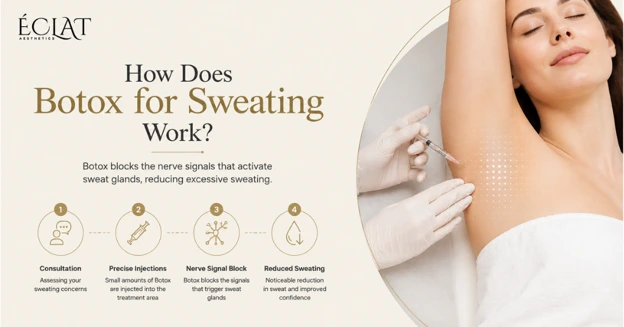
The same basic nerve-blocking ability that allows Botox to relax facial muscles can also be used to reduce sweat gland activity.
Botulinum toxin temporarily interferes with specific chemical signals released by nerves. In cosmetic treatments, this reduces the nerve signals that trigger certain muscles to contract. Mayo Clinic explains that Botox works by blocking selected chemical signals from nerves and that the medication is used not only for wrinkles but also for medical conditions including excessive sweating.
For underarm hyperhidrosis, the treatment targets nerve signals involved in activating sweat glands.
When those signals are temporarily interrupted, the treated sweat glands produce considerably less sweat. The goal is not to shut down your body's entire ability to sweat. Treatment is localized to the injected area, so the body's many other sweat glands continue functioning normally.
This makes Botox for sweating very different from simply covering sweat with deodorant. Instead of addressing odor or moisture after sweating occurs, the treatment reduces the nerve stimulation responsible for excessive sweat production in the treated underarms.
Is Underarm Botox FDA Approved?
Yes. BOTOX is specifically indicated for the treatment of severe primary axillary hyperhidrosis that has not been adequately managed with topical agents.
This distinction matters because Botox is sometimes discussed online for excessive sweating involving the hands, feet, scalp, face, and other areas. The official prescribing information states that the safety and effectiveness of BOTOX for hyperhidrosis in body areas other than the underarms have not been established.
For this reason, anyone considering Botox for sweating should be evaluated by an experienced medical provider who can determine whether their condition and treatment area are appropriate.
Who May Consider Botox for Underarm Sweating?
Underarm Botox is generally considered when excessive sweating has become difficult to control with topical treatments.
Some people find that prescription-strength or clinical-strength antiperspirants provide adequate relief. Others continue to experience significant sweating despite these measures.
When sweating frequently soaks through shirts, requires several clothing changes during the day, creates persistent visible sweat marks, or causes someone to avoid particular fabrics, colors, work situations, or social events, it may be worth discussing other treatment options with a healthcare provider.
The FDA-approved indication specifically focuses on severe primary axillary hyperhidrosis that is inadequately managed with topical treatments.
Your provider should also review your medical history to determine whether another condition could be contributing to excessive sweating before recommending treatment.
What Happens During an Underarm Botox Treatment?

An underarm Botox appointment is different from cosmetic Botox performed on the forehead or around the eyes because the goal is to treat the area containing overactive sweat glands.
Your provider first evaluates the underarms and determines the appropriate treatment area. Botox is then administered through multiple small injections distributed across the affected skin.
In clinical trials supporting BOTOX treatment for severe primary axillary hyperhidrosis, patients received injections throughout both underarm treatment areas. The official BOTOX professional information describes a recommended total dose of 100 units for axillary hyperhidrosis, divided between the two underarms, although actual treatment decisions must be made by the treating medical professional.
The injections themselves are relatively superficial compared with many other medical procedures. Patients may feel brief pinching or stinging with each injection, but the treatment does not involve surgery or incisions.
Your provider will explain what to expect before treatment and provide individualized aftercare instructions afterward.
How Effective Is Botox for Excessive Sweating?
Botox has been studied specifically for severe primary underarm hyperhidrosis.
The official BOTOX professional information describes randomized clinical trials in patients with persistent primary axillary hyperhidrosis and reports meaningful improvements in disease severity among treated patients.
The treatment does not permanently destroy the sweat glands. Instead, it temporarily reduces the nerve signaling that activates them.
This means sweating will eventually return as the effect of the treatment wears off. For many patients, however, several months of improved sweat control can make a meaningful difference in daily life.
How Long Does Botox for Sweating Last?
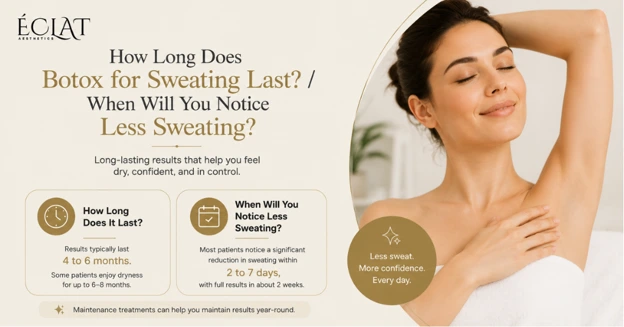
One advantage of treating underarm hyperhidrosis with Botox is that the results can last significantly longer than the daily effect of antiperspirant.
According to BOTOX's official professional information, treatment has been shown to provide more than six months of improvement for severe primary axillary hyperhidrosis in appropriate patients whose symptoms were not adequately managed with topical treatments.
Individual duration varies.
Some patients may notice sweating gradually returning sooner, while others may continue experiencing reduced sweating for longer. Botox does not suddenly stop working overnight. As nerve signaling recovers, sweat gland activity gradually returns.
When symptoms begin interfering with daily activities again, your provider can evaluate whether repeat treatment is appropriate.
When Will You Notice Less Sweating?
Unlike an antiperspirant applied immediately before leaving home, Botox works through a biological process involving nerve signaling.
Because of this, patients should not expect complete results immediately after leaving their appointment.
Improvement develops as the botulinum toxin begins affecting the targeted nerve endings. Your provider can explain the expected timeline and when it makes sense to evaluate the treatment response.
If sweating has not improved as expected, it is better to return for professional assessment rather than assuming that additional injections are automatically needed.
Will You Sweat More Somewhere Else?
A common concern is whether blocking sweat production in the underarms will cause the body to compensate by dramatically increasing sweating elsewhere.
Underarm Botox only affects the nerve signals in the areas that are treated. It does not disable the body's overall cooling system. Humans have sweat glands throughout the body, and the underarms represent only one portion of the body's total sweat-producing surface.
The goal of treatment is to bring unusually excessive underarm sweating under better control—not eliminate the body's normal ability to regulate temperature.
Patients with generalized sweating or sweating affecting multiple unrelated areas should discuss those symptoms with a healthcare provider, because they may require evaluation for a different underlying cause.
Take Control of Excessive Underarm Sweating
If excessive sweating is influencing what you wear, how often you change clothes, or how comfortable you feel in social or professional settings, you do not necessarily have to continue relying on deodorant alone.
At Eclat Medical Aesthetics in Alpharetta, Botox is among the neurotoxin treatments offered by the practice, and Eclat's existing Botox education identifies excessive underarm sweating as one of the concerns Botox can help address.
A personalized consultation can help determine whether your symptoms are consistent with hyperhidrosis and whether Botox is an appropriate treatment option for you.
Schedule a consultation with Eclat Medical Aesthetics to learn more about Botox for excessive underarm sweating and your personalized treatment options.
Is Underarm Botox the Same as Cosmetic Botox?
The medication may be the same onabotulinumtoxinA, but the treatment goal and injection technique are different.
Cosmetic Botox is injected strategically into selected facial muscles to temporarily reduce movement responsible for expression lines. Eclat Medical Aesthetics offers neurotoxins such as Botox, Dysport, and Xeomin for facial concerns involving wrinkles and repetitive muscle movement.
With hyperhidrosis treatment, Botox is injected into the underarm skin to reduce nerve stimulation of sweat glands rather than relax muscles for aesthetic purposes.
Because the treatment areas, dosing, anatomy, and goals differ, experience with medical neurotoxin treatment is important.
Does Underarm Botox Stop Body Odor?
Botox is primarily used in this setting to reduce sweat production.
Body odor develops when sweat and substances on the skin interact with bacteria. Because underarm Botox may significantly reduce moisture in the treated area, some patients may notice changes in odor as sweating decreases, but odor reduction is not the primary FDA-approved purpose of the treatment.
Deodorant and hygiene may still be useful even when sweating is substantially improved.
If unusually strong or changing body odor is your primary concern rather than excessive sweating, discussing it with a healthcare professional can help determine whether another cause should be investigated.
What Are the Possible Side Effects of Botox for Hyperhidrosis?
Like any prescription treatment, Botox can cause side effects and is not appropriate for everyone.
The official prescribing information states that BOTOX should not be administered when there is an infection at the proposed injection site or in patients with known hypersensitivity to botulinum toxin products or their formulation components.
BOTOX products also carry a boxed warning regarding the potential for toxin effects to spread beyond the injection area. Symptoms can include generalized weakness, difficulty swallowing, speech changes, or breathing problems, although the official professional information notes that no definitive serious adverse-event reports of distant toxin spread were associated with treatment of severe primary axillary hyperhidrosis at the recommended dose.
This is one reason Botox should be administered by a qualified medical professional who can review your health history, medications, and treatment suitability.
Can Anyone Get Underarm Botox?
No treatment is appropriate for every patient.
Before receiving Botox, you should tell your provider about your medications, previous botulinum toxin treatments, allergies, neurological or muscular conditions, pregnancy or breastfeeding status, and any infection or irritation in the treatment area.
It is also important to establish whether you truly have primary hyperhidrosis.
The official BOTOX guidance specifically recommends evaluating potential causes of secondary hyperhidrosis before treatment.
For example, if excessive sweating suddenly begins after years without symptoms or occurs throughout the entire body, your provider may recommend medical evaluation before pursuing an injectable treatment.
Botox vs. Antiperspirants for Hyperhidrosis
Antiperspirants are often the first approach for excessive underarm sweating because they are easy to use and do not require injections.
For mild or moderate sweating, they may be sufficient.
The role of Botox becomes more relevant when severe primary underarm sweating remains inadequately controlled despite topical agents. This is also the population covered by BOTOX's FDA-approved hyperhidrosis indication.
The two approaches also work differently. Antiperspirants temporarily reduce sweat flow at the surface of the skin, while Botox interferes with the nerve signaling responsible for stimulating sweat glands in the treated area.
A consultation can help determine whether it makes sense to continue topical therapy or explore another option.
Is Botox for Sweating Permanent?
No. Botox for sweating is a temporary treatment.
The nerve-blocking effect gradually wears off, which means the treated sweat glands eventually begin responding to nerve signals again.
Official BOTOX information reports more than six months of improvement in severe primary axillary hyperhidrosis for many treated patients, but repeat treatment may eventually be needed if symptoms return.
Some people prefer to schedule another appointment once they begin noticing more moisture. Others wait until sweating becomes significantly bothersome again.
Your maintenance schedule should be based on your individual response rather than assuming everyone needs injections on exactly the same date.
Why Choosing an Experienced Provider Matters
Treating hyperhidrosis involves more than simply injecting Botox into the underarms.
A provider must first determine whether your excessive sweating appears consistent with primary axillary hyperhidrosis or whether another medical cause should be considered. The treatment area must then be identified accurately so that injections reach the region responsible for excessive sweat production.
Botox is also a prescription medication with specific contraindications, precautions, and dosing recommendations.
At Eclat Medical Aesthetics, neurotoxin treatments begin with individualized assessment and are performed with an emphasis on targeted treatment and patient safety.
This personalized approach is particularly important when neurotoxins are being considered for a concern beyond facial wrinkles.
Schedule your appointment with Eclat Medical Aesthetics today to learn whether underarm Botox could help you feel more comfortable and confident throughout your day.
Find Hyperhidrosis Treatment in Alpharetta
Living with excessive sweating can affect much more than your underarms. It can influence your clothing choices, professional interactions, exercise routine, and confidence in situations where visible sweat may make you uncomfortable.
If antiperspirants are no longer providing enough control, it may be time to discuss other options.
At Eclat Medical Aesthetics, patients looking for hyperhidrosis treatment in Alpharetta can schedule a consultation to discuss excessive underarm sweating and determine whether Botox may be appropriate based on their symptoms and medical history. Eclat's Botox guidance recognizes the use of Botox for reducing excessive underarm sweating.
Frequently Asked Questions
Does Botox really work for excessive sweating?
BOTOX is FDA-approved for severe primary axillary hyperhidrosis that has not been adequately controlled with topical treatments. Clinical studies demonstrated meaningful improvement in patients treated for excessive underarm sweating.
How does Botox for sweating work?
Botox temporarily blocks chemical signaling from nerves. When used for underarm hyperhidrosis, this reduces the nerve stimulation that activates sweat glands in the treated area, resulting in less sweat production. Botox is also medically used for other conditions involving abnormal nerve signaling.
How long does underarm Botox last?
Official BOTOX information reports that treatment can provide more than six months of improvement in severe primary axillary hyperhidrosis for appropriate patients. Individual results and retreatment timing can vary.
Is underarm Botox FDA approved?
Yes. BOTOX is FDA-approved for adults with severe primary axillary hyperhidrosis that is inadequately managed with topical agents. Its safety and effectiveness for hyperhidrosis in other body areas have not been established.
Does underarm Botox hurt?
Patients generally receive multiple small injections throughout the underarm treatment area, so brief pinching or stinging can occur. Comfort varies between individuals, and your provider can explain what to expect before the procedure.