
Chemical peels have long been celebrated as one of the most effective tools in medical aesthetics, capable of transforming dull, uneven, or blemish-prone skin into something luminous and renewed. Yet for patients with deeper skin tones, Fitzpatrick types IV through VI, the question of safety is not just a formality. It is a deeply valid concern rooted in the unique physiology of melanin-rich skin and a history of aesthetic treatments that were not always designed with every complexion in mind.
The short answer is yes, chemical peels can be both safe and remarkably effective for darker skin tones, but only when the right peel is selected, the correct concentration is used, and the treatment is performed by a provider with genuine expertise in diverse skin types. At Éclat Medical Aesthetics in Alpharetta, we have built our chemical peel protocols around exactly this understanding, ensuring that every patient, regardless of skin tone, receives a treatment that honors the complexity of their skin rather than working against it.
Why Skin Tone Matters in Chemical Peel Treatments
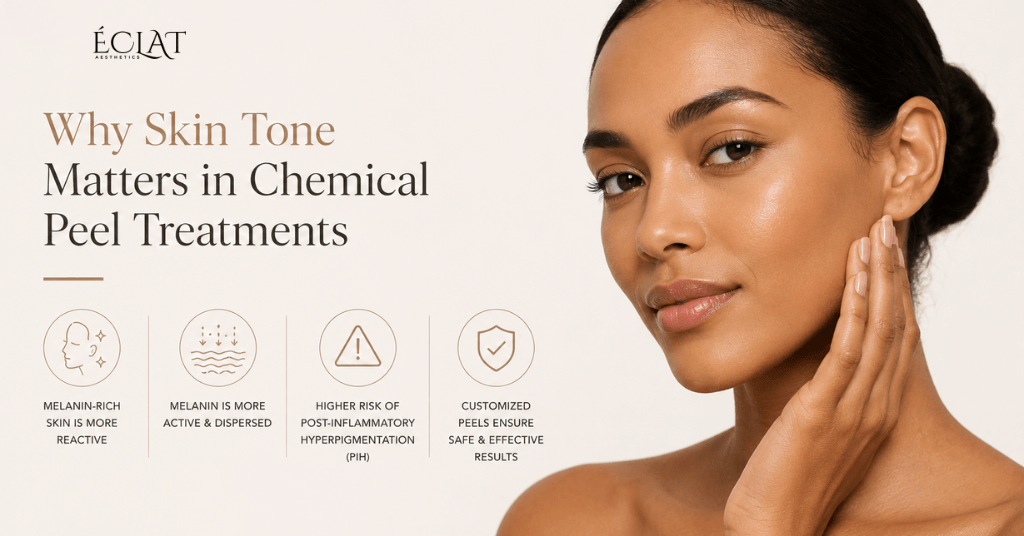
To understand the safety considerations around chemical peels for darker complexions, it helps to understand what makes melanin-rich skin different at a biological level. Melanocytes, the cells responsible for producing melanin, are present in roughly equal numbers across all skin tones. However, in darker skin, those melanocytes are far more active and produce larger, more dispersed melanin granules. This makes the skin exceptionally reactive to trauma, inflammation, and irritation.
When darker skin is subjected to an overly aggressive peel or an acid concentration that exceeds what the skin can tolerate, the inflammatory response triggers a process called post-inflammatory hyperpigmentation, commonly referred to as PIH. This means that instead of revealing brighter skin, an improperly administered peel can leave behind patches of darkening that are sometimes more pronounced than the original concern being treated. For this reason, the depth of a peel, its acid type, its concentration, and the preparation protocol all need to be carefully calibrated for everyone.
"The goal is never to simply resurface. It is to stimulate renewal without triggering the very melanin responses that darker skin is most prone to."
It is also worth noting that darker skin tends to have a more robust and thicker dermis, which offers certain protective advantages. Keloid scarring, while often cited as a risk, is far less of a concern with chemical peels than with surgical procedures, because even medium-depth peels do not typically penetrate deeply enough to affect the dermal layers where keloid formation occurs. This distinction matters because it separates real, evidence-based caution from outdated generalizations that have historically kept patients of color from accessing treatments they could safely benefit from.
Which Chemical Peels Does Éclat Offer, and Which Are Best for Darker Skin?
Not all chemical peels are created equal, and the distinction between peel types is particularly meaningful for patients with Fitzpatrick skin types IV through VI. At Éclat Medical Aesthetics, we offer three carefully chosen peels, each suited to different skin concerns and depths of treatment. Here is how each one interacts with deeper skin tones.
Peel Offered at Éclat | Depth / Type | Darker Skin Suitability | Key Benefits |
Illuminize Peel | Superficial / Mild | Excellent | Fine lines, texture, tone, sun-damaged skin and superficial scarring. No downtime, can be repeated every 2 weeks. Lowest PIH risk of the three options. |
RDS Peel (Factor V) | Superficial / Restorative | Excellent | Uses ethically derived growth factors and stem cell technology to promote cellular regeneration and collagen production. Gentle enough for reactive skin; recommended every 10 days for 4 to 6 sessions. |
Vitalize Peel | Moderate / Medium | Good with Prep | Goes deeper than the Illuminize to address melasma, sunspots, acne scarring and deeper lines. Mild redness and moderate peeling expected. Proper pre-treatment priming is important for darker skin tones. Recommended every 3 to 4 weeks for 3 to 6 sessions. |
At Éclat, the Illuminize Peel and RDS Factor V Peel are ideal starting points for patients with darker skin tones because of their superficial depth and low inflammatory potential. The Vitalize Peel can deliver impressive results for concerns like melasma and acne scarring in deeper complexions, but it requires a proper pre-treatment priming regimen to minimize the risk of post-inflammatory hyperpigmentation. Our providers will assess your skin during a consultation and recommend the specific peel that is right for your tone, sensitivity, and goals.
Conditions Chemical Peels Can Address in Deeper Skin Tones
One of the most rewarding aspects of offering chemical peels to patients with richer skin tones is the breadth of concerns that can be meaningfully improved. Many of these patients come to us having been told by previous providers that their options are limited, when the limitation was simply the provider's familiarity with diverse skin types rather than the treatment itself.
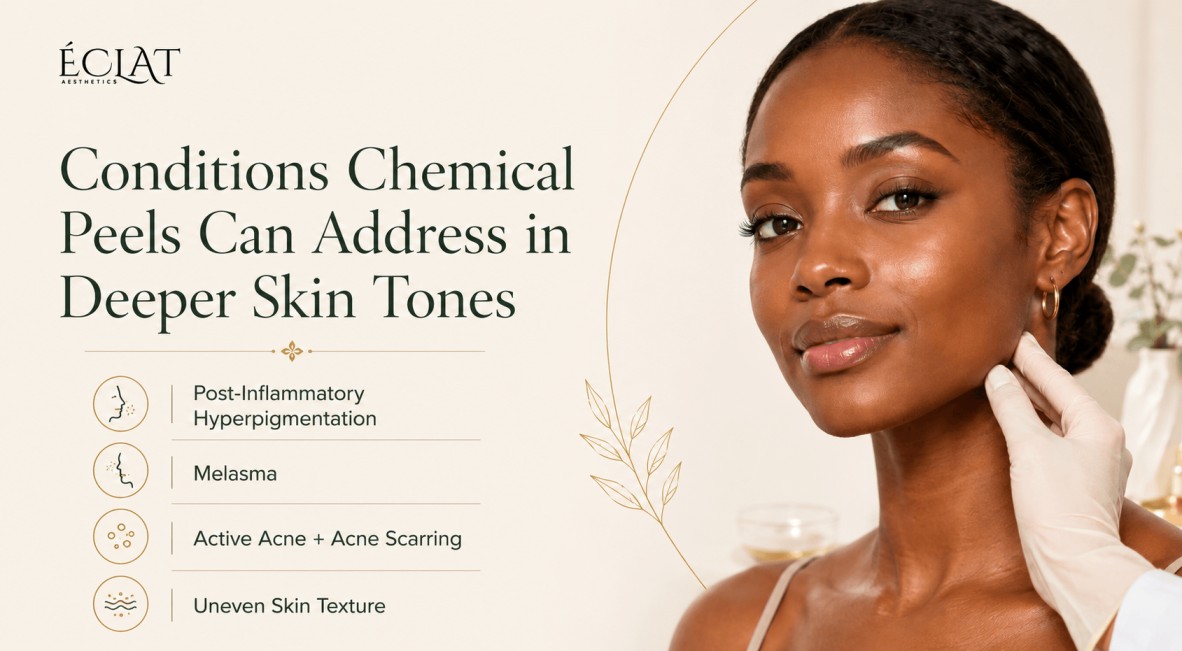
- Post-Inflammatory Hyperpigmentation
Dark spots left behind by acne, insect bites, or minor trauma respond well to mandelic and salicylic acid peels that gently resurface the upper layers of skin.
2. Melasma
This hormonally driven pigmentation condition is extremely common in women of color and responds favorably to a combination of lactic acid peels and topical brightening agents.
3. Active Acne and Acne Scarring
Salicylic acid peels are particularly effective because they penetrate the pore lining to dissolve congestion while simultaneously reducing the inflammation that leads to PIH.
4. Uneven Skin Texture
Glycolic and lactic acid peels at appropriate concentrations smooth the surface of the skin by accelerating the shedding of dead cells and stimulating collagen renewal beneath.
Ready for Brighter, More Even Skin?
Book a complimentary skin consultation with our specialists at Éclat Alpharetta
How to Prepare Your Skin and What to Expect After
Proper preparation is what separates a safe, effective peel from one that causes more harm than good. At Éclat, we begin every chemical peel journey with a comprehensive skin consultation to assess skin type, identify underlying concerns, and determine whether any pre-treatment priming is needed. For patients with darker skin tones, this preparation phase is particularly important because it helps the skin respond more predictably to the peel acids.
In the weeks leading up to a peel, we typically recommend a priming regimen that may include a daily topical retinoid to accelerate cell turnover, a hydroquinone or azelaic acid brightening agent to suppress melanin production proactively, and consistent use of a broad-spectrum SPF 30 or higher sunscreen. This three-part foundation essentially tells the melanocytes to stand down before we introduce the chemical stimulus of the peel itself, significantly reducing the likelihood of PIH.
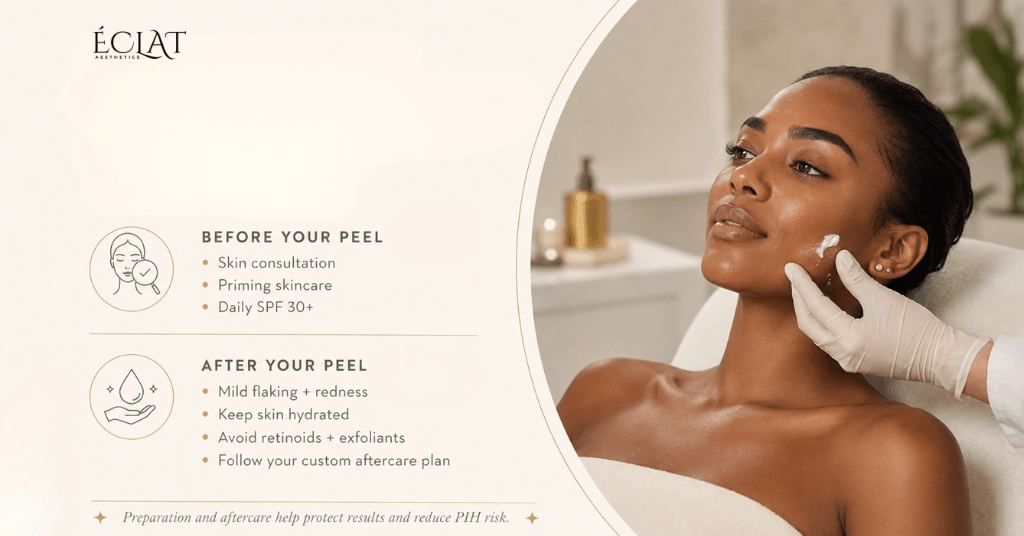
After the peel, the recovery period depends on the depth of the treatment chosen. Superficial peels typically produce mild flaking and some redness for two to four days, during which the skin should be kept hydrated and protected from sun exposure. Patients should avoid active skincare ingredients like retinoids, exfoliants, and vitamin C serums during the healing window, as these can over-stimulate skin that is in the process of renewing itself. We always provide a detailed aftercare plan specific to your skin tone and the peel received, because what you do in the days following your peel is just as important as the treatment itself.
Why Expertise in Diverse Skin Types Is Non-Negotiable
The aesthetic medicine field has historically been built around research conducted predominantly on lighter skin tones, and while this is changing, the legacy of that imbalance means that not every provider has the training necessary to safely treat Fitzpatrick types IV through VI. When selecting a medical spa for a chemical peel, patients with darker skin tones should ask directly about their provider's experience with diverse complexions, what peels are used specifically for deeper skin types, and how PIH is managed in their protocols if it occurs.
At Éclat Medical Aesthetics, our team has made an intentional commitment to inclusive aesthetic medicine. Our providers regularly train on the latest research in pigmentation science, and our treatment menus are built to serve the full spectrum of complexions that make up our Alpharetta community. We understand that a patient with Fitzpatrick type V skin is not simply a patient with more melanin. They are a patient whose skin has its own biology, its own sensitivities, and its own extraordinary potential for luminosity when treated with knowledge and care.
We also take a long-view approach to Chemical peel treatments. Rather than recommending an aggressive single-session peel that promises dramatic results quickly, we typically guide our patients of color through a series of lighter peels spaced four to six weeks apart. This incremental approach allows us to track how the skin responds, adjust concentrations as needed, and achieve meaningful cumulative results without the inflammatory risk that comes from going too deep too fast. The goal is always skin that is genuinely healthier rather than simply treated.
Skin That Reflects Who You Are
Our team creates personalized peel protocols for every skin tone. Discover what your skin is capable of with a treatment designed specifically for you.
Frequently Asked Questions
Can chemical peels cause permanent darkening in deeper skin tones?
Permanent darkening from a chemical peel is extremely rare and almost always preventable with proper technique, appropriate peel selection, and a solid pre-treatment priming regimen. When darkening does occur, it is typically post-inflammatory hyperpigmentation, which is a temporary condition that fades over several weeks to months with correct aftercare and brightening agents.
Is there any downtime after a chemical peel for darker skin?
Superficial and light-medium peels typically involve minimal downtime. Most patients experience mild redness and some flaking for two to four days after the treatment.
Can I combine a chemical peel with other treatments like microneedling or facials?
Yes. Chemical peels work well as part of a broader skin health plan that may include microneedling, brightening facials, or topical treatment regimens. However, combining active treatments requires careful spacing to avoid over-stimulating the skin.
Is sun protection really that important after a chemical peel for darker skin?
Absolutely, and it cannot be overstated. Sun exposure after a chemical peel on melanin-rich skin is one of the fastest ways to trigger post-inflammatory hyperpigmentation and undo the results of the treatment.
Are chemical peels suitable for pregnant or breastfeeding patients with darker skin?
We take a conservative approach for pregnant and breastfeeding patients. Some ingredients used in certain peel formulations are generally avoided during pregnancy, and we always require clearance from your obstetrician before proceeding with any active treatment during this period.